Introduction
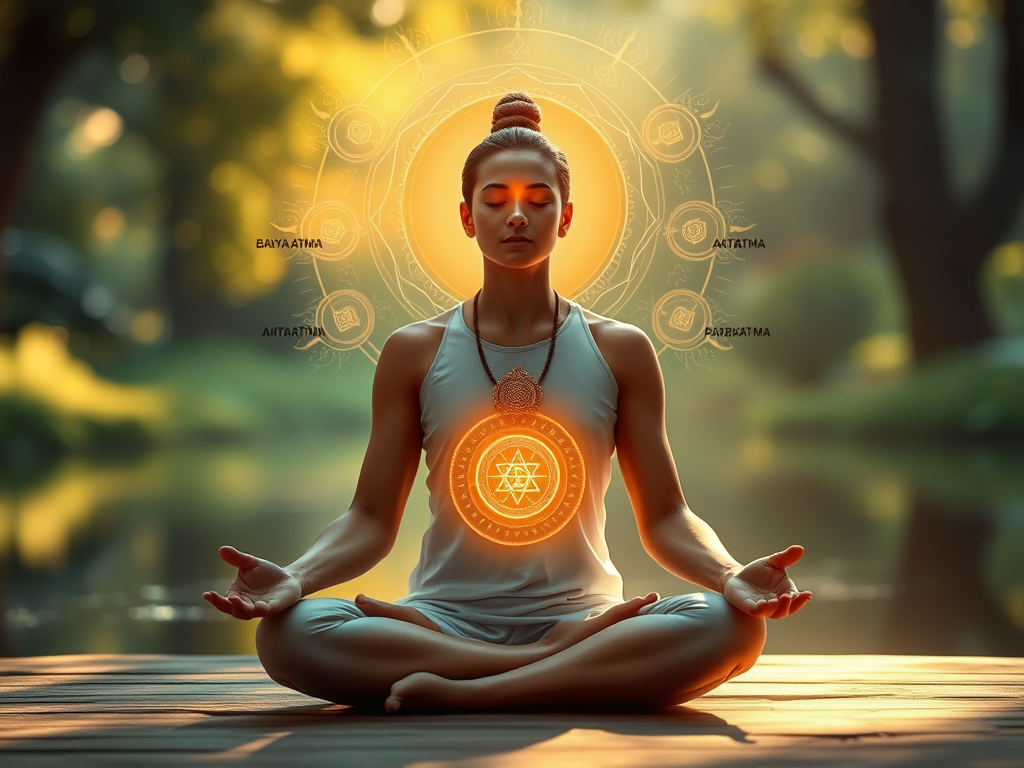
Love and emotions are fundamental to human experience, yet they remain abstract and often elusive concepts. While we express love through words and actions, its true essence transcends mere physical or verbal expression. From a yogic perspective, these emotions are deeply connected to the Atman, the subtle, unmanifested inner Self that resides within every individual.
This article explores how love and emotions arise from the inner layers of Atman, the classification of Atman into Bahya Atma, Antaratma, and Paramatma, and how yogic practices help deepen our understanding and experience of these profound feelings by connecting us to our true nature.
Love and Emotions as Abstract Manifestations
Love and emotions are intangible experiences that manifest through human expressions such as speech, gestures, and behavior. Despite their abstract nature, humans have developed language and symbols to communicate these feelings, yet words often fall short of capturing their full depth.
From the yogic viewpoint, love and emotions are not random or purely psychological phenomena; they are expressions of the Antaratma—the inner self that encompasses the mind, intellect, desires, and emotions. This inner self is a subtle layer of Atman, where feelings arise and are experienced.
The Layers of Atman: Bahya Atma, Antaratma, and Paramatma
To understand the connection between emotions and the inner Self, it is essential to recognize the threefold classification of Atman:
- Bahya Atma (External Self):
The physical body and sensory organs that interact with the external world. This layer is subject to change and impermanence. - Antaratma (Inner Self):
The subtle inner faculties including the mind, intellect, emotions, desires, and memories. This is the seat of love, fear, joy, and sorrow. - Paramatma (Supreme Self):
The highest, transcendental Self beyond all qualities and dualities. It is the universal consciousness that pervades all beings.
Love and emotions primarily arise from the Antaratma, but their true source and ultimate fulfillment lie in the realization of Paramatma.
Yogic Practices to Deepen Emotional Awareness
Yogic disciplines provide practical tools to connect with the Antaratma and transcend the fluctuations of the mind and emotions:
Meditation and Concentration
- Meditation helps quiet the restless mind, allowing deeper access to the inner self where emotions arise.
- Concentration on subtle points within the body, such as the heart or the space between the eyebrows, refines awareness of emotional states.
Breath Control (Pranayama)
- Regulating the breath balances the flow of prana (life energy), calming emotional turbulence.
- Practices like kumbhaka (breath retention) help unify prana and apana, stabilizing the mind and emotions.
Kundalini Awakening
- Awakening the dormant Kundalini energy purifies the subtle body and opens the chakras, especially the Anahata (heart chakra), which governs love and compassion.
- As Kundalini rises, emotional blockages dissolve, leading to a more expansive and unconditional experience of love.
Transforming Emotions through Atman Realization
When the practitioner realizes the Atman, emotions transform from transient, often turbulent experiences into reflections of the eternal bliss and unity of the inner Self:
- From Attachment to Detachment:
Emotions are no longer driven by craving or aversion but are experienced with equanimity. - From Conditional to Unconditional Love:
Love transcends personal desires and becomes a universal, all-encompassing compassion rooted in Paramatma. - From Sorrow to Bliss:
The realization of Atman dissolves the root causes of suffering, revealing the blissful nature of existence.
Practical Implications for Daily Life
Understanding the connection between love, emotions, and Atman has profound effects on how one lives:
- Emotional challenges become opportunities for self-inquiry and growth.
- Relationships deepen as love is experienced as a reflection of the universal Self.
- Inner peace and resilience increase, reducing reactivity to external circumstances.
Conclusion
Love and emotions, though abstract and subtle, are deeply connected to the inner Self, the Atman. By recognizing the layers of Atman—Bahya Atma, Antaratma, and Paramatma—and engaging in yogic practices such as meditation, breath control, and Kundalini awakening, one can transform emotional experience and realize the true nature of love.
This yogic perspective invites seekers to explore their inner world with compassion and discipline, uncovering the eternal source of love and bliss within.




 Rise of Kalki
Leave a comment