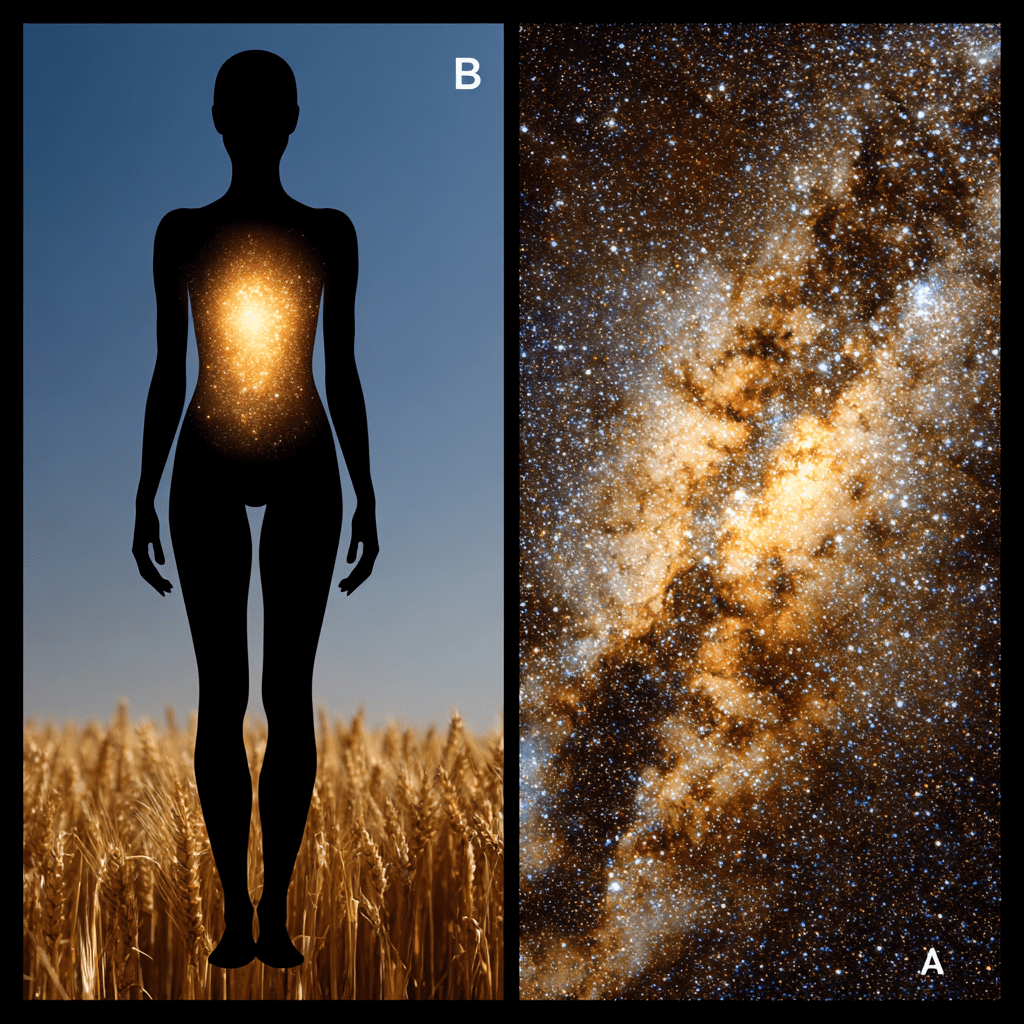
Two Creations, Two Toolkits: Why the Big Bang Isn’t Sṛṣṭi
Intention
To show—carefully, accessibly, and with evidence—that what modern cosmology calls the Big Bang and what Indian scriptures call sṛṣṭi (“creation”) are not the same kind of claim. They answer different questions with different methods, live in different domains (outer physics vs inner phenomenology), and serve different aims (explanation vs liberation). We’ll set them side-by-side without pitting them against each other.
Two questions that both get called “creation”
Cosmology’s question: How did the observable universe evolve from an early hot, dense state to what we see now? This is a third-person, measurement-driven question answered with telescopes, detectors, math, and statistics.
Scriptural sṛṣṭi’s question: How do worlds appear within awareness, and how can that appearance be transformed to end suffering (mokṣa)? This is a first-person, practice-driven question answered with disciplined attention, breath, and insight—mapped with terms like prāṇa, śakti, hṛdaya (heart), nābhi (navel).
Because English uses the single word “creation” for both, it’s easy to conflate them. Let’s keep the labels straight: Big Bang (outer, empirical) versus sṛṣṭi (inner, soteriological).
Big Bang 101
- Very early universe (including a likely phase of inflation, a burst of super-fast expansion). (NASA Science)
- Big-Bang nucleosynthesis (~first minutes): light elements (H, He, Li) formed in specific ratios predicted by the model. (NASA Science; Astrophysics Data System; NASA Technical Reports Server)
- Recombination (~380,000 years): electrons and protons combined into neutral atoms; light decoupled from matter, leaving the cosmic microwave background (CMB)—a relic glow we still measure today. (WMAP, others)
- Structure formation: gravity amplified small fluctuations seen in the CMB into galaxies and clusters; the universe’s large-scale expansion is observed via galactic redshift (Hubble–Lemaître law). (NASA Science)
- Age and parameters: precision measurements, especially from ESA’s Planck mission, fix the age at ~13.8 billion years within the standard ΛCDM model. (European Space Agency)
- Why scientists take this seriously: it’s a consilience of evidence—independent pillars (expansion, CMB, primordial abundances, structure growth) that line up quantitatively. (NASA Science; WMAP)
A quick mental picture: Imagine baking bread with raisins. As the dough (space) rises, the raisins (galaxies) all recede from each other; no raisin is the “center.” That’s cosmological expansion.
Soteriological sṛṣṭi
Praśna Upaniṣad: “Like spokes in a hub, everything is set in prāṇa … as Prajāpati you move in the womb.” (2.6–2.7)
Brahma-Vidyā Upaniṣad: “The universe is situated in the navel, shining like the sun.”
Brahma Upaniṣad: “All the deities are in the heart; there the life-breaths are established.”
Śiva Saṃhitā: the body is a microcosm (brahmāṇḍa); inner lotuses and powers chart a cosmography for practice.
Śiva Sūtras: “One brings about creation of one’s own measure” (3.17); “by uniting the circle of powers, there is dissolution of the universe” (1.60).
Taken together, these are not astrophysical claims. They say: the world you live in is rendered in consciousness, patterned by prāṇa/śakti, and trainable through breath and attention. “Creation” (sṛṣṭi) is creative—an ongoing first-person genesis you can refine.
Five decisive axes of difference
| Big Bang (cosmology) | Sṛṣṭi (Indian scriptures) |
|---|---|
| External, physical spacetime with matter/energy | Internal, experiential consciousness/body field |
| Explanation & prediction of observations | Liberation (mokṣa) & transformation of perception |
| Third-person evidence: redshifts, CMB, element abundances; statistical inference | First-person praxis: meditation, prāṇāyāma, attention; lineage-tested phenomenology |
| Dynamics of GR + quantum fields; no personal agent | Prāṇa/śakti/cit as agentive creative power |
| No center to expansion (homogeneous/isotropic at large scales) | Heart/navel and subtle body as hubs of creation/dissolution |
These axes don’t merely differ—they incommensurate at key points. Trying to equate them collapses categories.
Multiple reasoning paths to the same conclusion (they’re not the same)
Definitional reasoning (what the words target)
“Creation” in cosmology = the state-evolution of the external universe. “Creation” in these texts = the appearance and re-appearance of a world in awareness. Different targets ⇒ different propositions.
Scale & locality reasoning
- Cosmology: expansion has no privileged center; every large region sees others receding. (NASA Science)
- Scripture: situates “the universe” in heart/navel; maps gods and powers in the body.
Incompatible localizations ⇒ not identical.
Causal–mechanistic reasoning
Cosmology’s causes are impersonal laws and initial conditions. Scripture’s cause is consciousness/energy as agent (Prajāpati as prāṇa). Different “engines” ⇒ different theories.
Methodological reasoning (how truth is tested)
- Cosmology: falsifiable predictions (CMB spectrum & anisotropy, light-element abundances). (WMAP; NASA Science)
- Scripture: repeatable praxis and intersubjective reports within a tradition; transformation, not parameter-fits, is the success criterion.
Different validation regimes ⇒ non-comparable truth-claims.
Teleology reasoning (what it’s for)
Cosmology doesn’t aim to deliver liberation. Soteriological discourse doesn’t aim to measure Hubble constants. Divergent purposes ⇒ distinct enterprises.
Reductio (absurdity check)
If the Big Bang’s universe were literally inside a human body, CMB maps and galaxy surveys should show biological signatures—absurd. Therefore identity claim fails.
Linguistic–hermeneutic reasoning
Words like brahmāṇḍa, hṛdaya, prāṇa are technical in yoga/vedānta. Reading them as modern-physics placeholders (“prāṇa = dark energy”) is a category mistake.
Case studies in confusion
Case 1: “Singularity = Heart/Navel”
The mix-up: People see “universe in the navel/heart” and think “that sounds like a singularity.”
Why it’s wrong: A GR singularity is a breakdown in spacetime description; the heart/navel teachings are phenomenological centers for practice.
Fix: Translate by function, not by buzzword: heart/navel = hubs for rendering experience, not astrophysical points.
Case 2: “Prāṇa = Dark Energy”
The mix-up: Both “drive expansion” (so the story goes).
Why it’s wrong: Dark energy is an inferred term in the equations for cosmic acceleration; prāṇa is the felt power of life/breath and attention. Category mismatch in both ontology and epistemology. (NASA Science)
Fix: Keep prāṇa in the practice register; keep dark energy in the parameter register.
Case 3: “CMB = inner ‘radiance’”
The mix-up: Meditators report inner luminosity; the CMB is a literal relic glow.
Why it’s wrong: CMB is a measured blackbody spectrum across the sky; inner luminosity is first-person phenomenology. (WMAP)
Fix: Enjoy the metaphor, label it as metaphor, and don’t cross the wires.
Big Bang, in a bit more detail
- Expansion & redshift: The farther a galaxy, the more its light is redshifted, showing the metric expansion of space. That linear relation (distance ↔ speed) is the Hubble–Lemaître law. (NASA Science; Wikipedia overview)
- Relic light: The CMB is the cooled afterglow from when the universe became transparent; its tiny temperature ripples (tens of microkelvin) seed today’s cosmic structure. Missions like COBE/WMAP/Planck mapped it with increasing precision. (WMAP; European Space Agency)
- Light elements: The first minutes’ thermodynamics set the primordial abundances of hydrogen, helium, a trace of lithium. Observations broadly match the calculations—a nontrivial success. (NASA Science; Astrophysics Data System)
- Age & parameters: The Planck satellite’s CMB measurements pin down key parameters (matter content, curvature, expansion rate) and give an age of ~13.8 billion years. (European Space Agency)
None of this presumes or denies inner realization; it’s simply about the outer universe. That’s the whole point.
Productive complementarity
Rather than forcing matches, let each discourse do what it does best:
- Let cosmology model the history of spacetime with data-driven humility. We can celebrate new missions (e.g., SPHEREx) that will probe inflationary clues—without demanding that they speak to meaning or liberation. (The Washington Post, mission coverage)
- Let the scriptures guide the craft of perception—how attention, breath, and heart transform experience. Their “cosmology” is an inner cartography—hugely valuable on its own terms.
Where they can talk to each other:
- Metaphor & pedagogy: Using expansion/afterglow as metaphors can help teach meditative dynamics—if we flag them as metaphors.
- Ethics & awe: Both can deepen reverence for existence—cosmology via vastness and precision, scriptures via intimacy and transformation.
Where they shouldn’t be collapsed:
- Mechanism: Don’t swap prāṇa into Einstein’s equations, or the Friedmann equations into a yoga manual.
- Authority: Don’t ask a telescope to confer mokṣa, or samādhi reports to fix the Hubble constant.
A one-page comparison
| Feature | Big Bang | Sṛṣṭi |
|---|---|---|
| What’s being explained? | Origin & evolution of external cosmos | Genesis & transformation of experienced world |
| Tools | Telescopes, satellites (COBE/WMAP/Planck), math | Meditation, prāṇāyāma, mantra, inquiry |
| Signature evidence | Redshift, CMB, primordial H/He ratios | Stable phenomenology across practitioners/lineages |
| Who/what creates? | No agent; law-governed dynamics | Prāṇa/śakti/cit as creative agency |
| Why talk about it? | Predictive explanation | Soteriological transformation |
FAQs
Q1. If both talk about “creation,” aren’t they ultimately saying the same thing?
A. No. Same word, different referents. Cosmology tracks spacetime; scripture tracks experience.
Q2. Couldn’t prāṇa be the scientific force we haven’t discovered yet?
A. That’s speculation not supported by either side’s methods. Prāṇa is known through practice; scientific forces are inferred from measurements. Keep the registers clean. (NASA Science)
Q3. Does this mean science is “less spiritual” or scripture is “unscientific”?
A. Neither. Each is rigorous in its own frame. Problems arise only when we mis-scope their claims.
Bottom line
“Creation” is a polysemous word. In cosmology, it names the measured expansion history of the universe (supported by redshifts, the CMB, nucleosynthesis, and structure growth). (NASA Science; WMAP) In scripture, it names the ongoing rendering of a world in and as consciousness, centered in the lived body (heart/navel) and powered by prāṇa/śakti. These aren’t rivals. They are different languages for different tasks—one maps the outer sky, the other maps the inner sky.
We’ve clarified the category mistake. Next, we’ll zoom into one Sanskrit thread that makes the inner claim vivid: Praśna Upaniṣad’s portrait of prāṇa as Prajāpati, the creative Lord. In Article #3 — “Prāṇa as Prajāpati: The Physiology of Creation”, we’ll unpack how breath-life becomes creative engine, how yogic practices leverage that engine, and how to teach this responsibly without wandering into pseudo-science.





 Rise of Kalki
Leave a comment