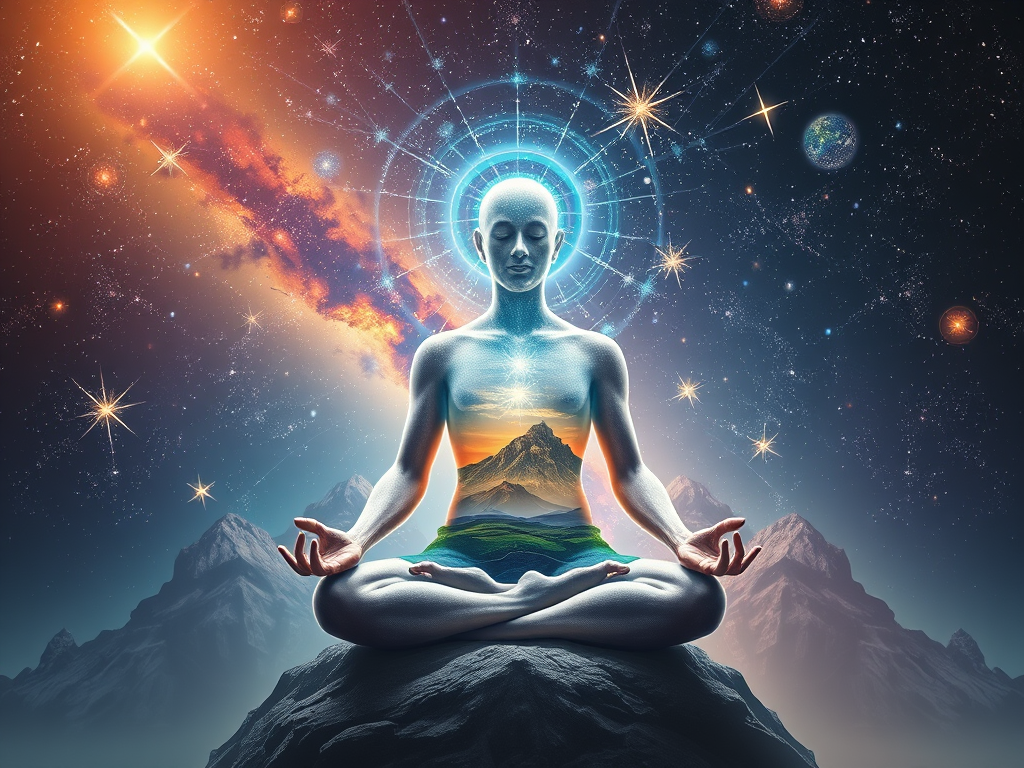
The Universe in the Navel: How Indian Seers Place Creation Inside the Human Being
Intention
To show—using short primary-text quotations (Sanskrit + translation) and easy analogies—that many classical Indian sources present “creation” as an inner phenomenon unfolding in and through the body–breath–consciousness of the human being. This is not a claim about astrophysics; it’s a contemplative map for practice and realization. We’ll build the idea step by step, so readers can see exactly what these texts are—and aren’t—saying.
Takeaway
In these sources, the body (piṇḍa) is a microcosm of the cosmos (brahmāṇḍa). The “world” shows up as a construction within awareness, structured by breath (prāṇa), energy (śakti), and attention. “Creation” is therefore something that happens through you, not merely to you.
A simple starting picture (an analogy)
Imagine you put on a VR headset. Nothing “out there” changes—your living room is still your living room—but the world you experience is rendered from within the headset. Look left: mountains. Look down: a river. The device isn’t the mountains, but it creates a world you can inhabit.

Indian seers often talk about “creation” in a similar way: not as a once-upon-a-time explosion of matter, but as the ongoing rendering of a world in consciousness, with the human body as the device and display. Breath is power, attention is steering, heart/navel are hubs, and the “cosmos” appears through that inward system.
They even say this explicitly.
Scriptures that say the body is a cosmos (microcosm = macrocosm)
Śiva Saṃhitā (a classical yoga compendium)
पारमेयमिदं गात्रं पंचभूतविनिर्मितम् ।
ब्रह्माण्डसंशकं दुःखसुखभोगाय कल्पितम् ॥
“This body, made of the five elements, is a microcosm of the universe, devised for the experience of pleasure and pain.”
ब्रह्माण्डसंज्ञके देहे यथादेशं व्यवस्थितः ।
“In the body known as the universe, [all things are] situated according to their places.”
पिण्डस्थं रूपसंस्थञ्च रूपस्थं रूपवर्जितम् ।
“The form that is in the body, the form that is in the forms, and that which is beyond form.”
These lines don’t tiptoe: they name the body brahmāṇḍa—a universe-in-miniature. The yogin’s interior is mapped like a sacred city: mountains, lotuses, energy flows, centers. It’s a cosmology for practice.
Brahma-Vidyā Upaniṣad
नाभिस्थाने स्थितं विश्वं शुद्धतत्त्वं सुनिर्मलम् ।
आदित्यमिव दीप्यन्तं रश्मिभिश्चाखिलं शिवम् ॥
“The universe is situated in the navel, the pure and stainless principle—shining like the sun, whose rays make all auspicious.”
Here, nābhi (navel) is an inner hub of power and attention.
Brahma Upaniṣad
हृदिस्था देवताः सर्वा हृदि प्राणाः प्रतिष्ठिताः … हृदि चैतन्ये तिष्ठति ॥
“All the deities are in the heart; in the heart the life-breaths are established … consciousness abides in the heart.”
The hṛdaya (heart) is the inner city of the gods, where prāṇas (vital winds) and cit (consciousness) dwell—again, inside.
Praśna Upaniṣad (teachings on prāṇa)
अरा इव रथनाभौ प्राणे सर्वं प्रतिष्ठितम् । (2.6)
“As spokes in the hub of a wheel, everything is set in prāṇa.”
प्रजापतिश्चरसि गर्भे त्वमेव प्रतिजायसे । (2.7)
“You (Prāṇa) move as Prajāpati in the womb; you yourself are ever being born.”
प्राणस्येदं वशे सर्वं … (2.13)
“All this is under the sway of Prāṇa.”
Prāṇa—what you feel breathing in your own chest—is exalted as the creative lord (Prajāpati) upon whom “everything” depends. The “cosmos” is located in the hub you can experience directly: your vital breath.
Śiva Sūtras (Kashmir Śaiva aphorisms)
स्वमात्रा निर्माणमापादयति (3.17)
“One brings about creation of one’s own measure.”
भेदतिरस्कारे सर्गान्तरकर्मत्वम् (3.36)
“With difference [perception] set aside, there is the power to form other creations.”
शक्तिचक्रसंधाने विश्वसंहारः (1.60)
“By uniting the circle of powers, there is dissolution of the universe.”
Creation and dissolution are seen as operations of consciousness—a shift in the way awareness configures experience.
Avadhūta Upaniṣad (non-dual consummation)
न निरोधो न चोत्पत्तिर्न बद्धो न च साधकः …
“There is neither destruction nor origination, neither bondage nor seeker …”
From the loftiest vantage, creation and destruction are ultimately not two (nor even truly occurring). That “meta” view helps explain why other texts can play so freely with “creation” as an inner appearance.
What do these claims mean?
Piṇḍa (the ‘body lump’) vs. Brahmāṇḍa (the ‘Cosmic Egg’):
The human body mirrors the whole. The small contains the pattern of the large.
Hṛdaya (heart) & Nābhi (navel):
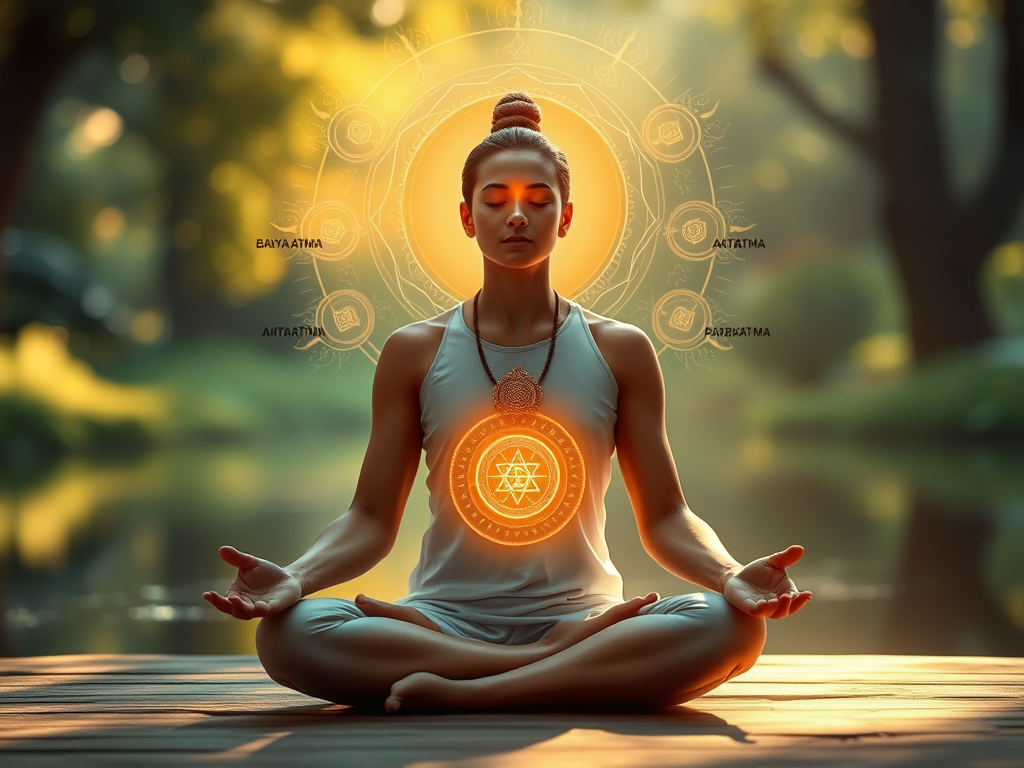
Not just organs; power-centers—hubs from which the “world” appears. Think of them as the motherboard’s sockets in a spiritual physiology.
Prāṇa (vital breath/energy):
Not merely oxygen or airflow. It’s the animating power felt as breath and life, often personified and treated as creative.
Śakti/Cit (power/consciousness):
The capacity to manifest experience; the light in which any “world” appears.
Sṛṣṭi–Sthiti–Saṃhāra (creation–maintenance–dissolution):
Not only cosmic cycles “out there,” but inner phenomenology—how perceptions arise, stabilize, and resolve within awareness.
Analogy: If consciousness is a projector, prāṇa is the lamp, attention is the lens, and hṛdaya/nābhi are the projection booth—then “creation” is the movie playing on the screen of your experience. You’re not merely watching it; you’re also the projector.
Why talk about “creation” at all?
Orientation for practice.
If you look for Truth only out there, you’ll keep running after receding horizons. These sources stake a claim: look here—breath, heart, attention. That’s where “worlds” arise for you.
A way to de-hypnotize perception.
Naming the body a “universe” loosens default realism (“things are just out there as they seem”) and invites a subtler stance: perception is built; it can be rebuilt.
Liberation as re-creation.
Yogic mastery isn’t merely a calmer nervous system. It’s the power to shape what appears—the sargāntara (“other creations”) of the Śiva Sūtras—up to dissolving the whole experiential world into nondual clarity.
Reminder: These are maps for transformation, not astrophysical reports. Reading them as literal astronomy is like reading a recipe as a weather forecast.
How the “inner creation” functions
- Attention gathers at a hub (hṛdaya or nābhi).
You sit, breathe, collect yourself. The “hub of the wheel” is established. - Prāṇa is regulated (prāṇāyāma; sometimes kumbhaka).
Breath steadies; energy patterns (vāyus) stabilize. - Nāḍī & Cakra system attunes.
The “wiring” of the subtle body (channels and centers) clears. Sensitivity rises; the projector’s lamp brightens. - Perception reconfigures.
The “movie” gets a new color grade. Space/time feel different. Self–world boundaries soften. Attention refines. - Creation/dissolution become first-person.
Now sṛṣṭi isn’t a tale: it’s felt. Worlds arise and resolve in awareness. This is the Śiva Sūtras’ “one brings about creation of one’s own measure.” - Nondual insight (sometimes).
In mature stages, the projector–screen distinction collapses. The Avadhūta stance—“no origination, no destruction”—isn’t a belief; it’s obvious. The language of “creation” remains useful as pedagogy.
Is this biomedicine? No. It’s a soteriological phenomenology—a careful account of how experience behaves under disciplined conditions.
Guardrails: what this isn’t
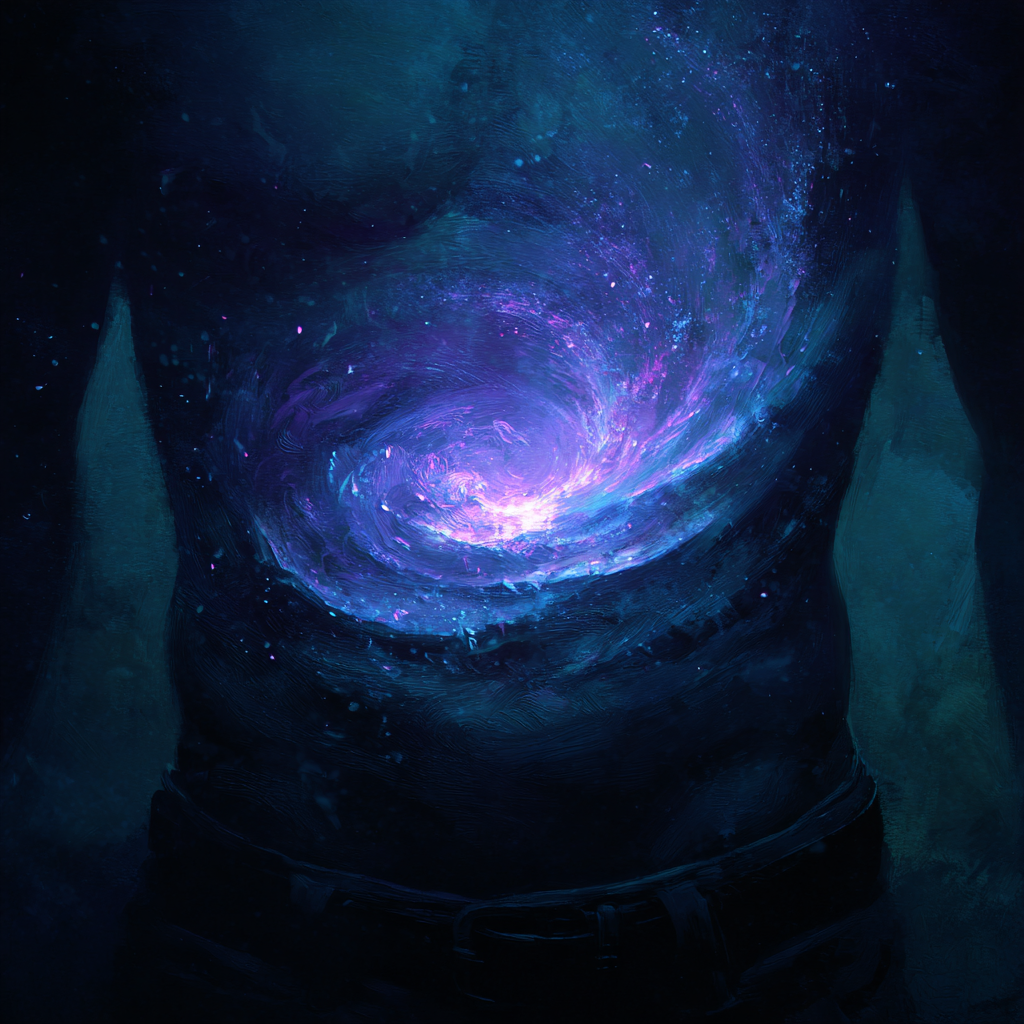
- It is not claiming that galaxies sit inside your abdomen.
- It is not replacing physics with Sanskrit.
- It is not saying prāṇa is “dark energy” or that hṛdaya = the organ pumping blood.
It is saying: the world you live in is rendered in consciousness—and the yoga tradition presents a trainable interface (breath–attention–centers) for that rendering. In that sense, “creation” is creative—an ongoing inner artistry.
A few short, annotated passages
Śiva Saṃhitā — Body named universe
“In the body known as the universe …”
Gloss: The text speaks of mountains, lotuses, powers—all inside the yogin’s subtle body. The cosmos is a map for practice, not a sky chart.
Praśna Upaniṣad — Prāṇa as hub and lord
“Like spokes in the hub, everything is set in prāṇa.”
“As Prajāpati, you (Prāṇa) move in the womb.”
Gloss: Prāṇa is praised as creative. For a practitioner: attend to breath with reverence; creation happens through it.
Brahma Upaniṣad — All gods in the heart
“All the deities are in the heart; in the heart the life-breaths are established.”
Gloss: The heart is not just an organ; it’s the seat of powers that pattern experience. Devatā-language points to qualities of awareness.
Brahma-Vidyā Upaniṣad — Universe in the navel
“The universe is in the navel … shining like the sun.”
Gloss: The navel is the engine room. Practices that center here (soft belly awareness, gentle kumbhaka) often report a radiant field.
Śiva Sūtras / Avadhūta — Consciousness as scene-shifter
“One brings about creation of one’s own measure.”
“No origination, no destruction.”
Gloss: Two vantage points: the artist (creating forms) and the open sky (beyond all forms). Both are true, at different resolutions.
Everyday illustrations (to make this less mystical)
- Kaleidoscope: Shake it and a new world appears. The pieces didn’t leave; their relations changed. Yogic “creation” is like changing the orienting relations of attention, breath, and feeling.
- Smartphone filters: The city stays the same; the filter transforms how it appears. Practice changes the filter factory—the very conditions that choose and apply filters.
- Music and key change: The same melody in a minor vs. major key can feel like a different world. Practice shifts the key signature of experiencing.
- Child’s face morphing to parent: Look long enough and you see the parent in the child. Microcosm–macrocosm means training the eye to notice whole-patterns inside humble parts—especially inside yourself.
How to read guide
- Say out loud that this is not astronomy.
It’s not trying to compete with cosmology; it’s answering a different question—how to liberate perception. - Keep Sanskrit terms when needed.
Don’t flatten prāṇa into “oxygen” or śakti into “energy” in the physics sense. Add short glosses (e.g., “prāṇa = animating breath-life felt in the chest”). - Mark analogies as analogies.
VR, filters, kaleidoscopes—these teach the shape of the claim. They are not one-to-one. - Invite experiments, not beliefs.
Two minutes of felt-breath at the navel, two at the heart, eyes soft—then ask: What changed? Turn doctrine into data.
FAQs
Q1. Are you saying the external world is unreal?
A. No. The texts say: your experienced world is co-constructed. That’s different from denying tables and galaxies. The claim is about how reality becomes present—and how that process can be refined.
Q2. Why this focus on belly/heart? What about the head?
A. Different traditions emphasize different hubs. Many yoga sources name navel/heart as principal centers because they are accessible and powerful in practice. You can easily test their effects.
Q3. Doesn’t “no origination” contradict “you create”?
A. They’re different zoom levels. At the level of appearances, forms arise (you can taste the “creative” feel). At the level of nondual insight, the ground is unmoved. Both perspectives educate different stages of the path.
Bringing it all together
- Primary sources repeatedly and explicitly interiorize the cosmos: the body is a universe, the heart houses powers, the navel is a hub, and prāṇa is lordly—“everything is set” in it.
- Creation is creative—an act or power within consciousness, trainable through breath and attention. Not a single bang back then, but an ongoing rendering now.
- Purpose: These teachings are tools. They recalibrate where we look, how we practice, and what we take “world” to mean—so that suffering eases and insight ripens.
- Ultimate frame: From the apex stance (Avadhūta), even “creation” dissolves as a notion. That doesn’t cancel the earlier claims; it grounds them.
In short: the yogic universe is not elsewhere. It arises as you, in you, for you—and those dynamics can be understood and refined.
What’s next
Everything above lives in the first-person and practice register. By contrast, Big Bang cosmology lives in the third-person and measurement register—redshifts, cosmic background radiation, primordial abundances. Both discuss “creation,” but they are not talking about the same thing or using the same tools.
Up next: “Big Bang ≠ Sṛṣṭi: Clarifying a Category Mistake.” We’ll set the Big Bang timeline next to the inner “creation” map and show—cleanly, respectfully, and decisively—why they don’t compete, and how comparison becomes fruitful only when we stop forcing them to match.


 Rise of Kalki
Leave a comment