Introduction: Ancient Battles, Modern Biology
The priests perform the yajna. From the sacred fire arises the Soma, which is offered to Indra. Strengthened by the Soma, Indra slays the demon Vritra and releases the celestial waters.
Traditionally, these stories are seen as myth or cosmic allegory. But what if this entire sequence—from ritual to Soma to battle—is a symbolic encoding of what happens inside your body?
What if the yajna is your immune activation, Soma is your biochemical modulation, and Indra is your immune defense mechanism? In this reinterpretation, the human body becomes the battlefield. The Vedic wars, we propose, represent cellular intelligence, immune defense, and healing dynamics unfolding within.
Devas, Asuras, and Divine Weapons: An Internal Allegory
The Vedas are full of vivid characters:
- Devas (gods): Radiant, organized, and protective forces.
- Asuras (demons): Disruptive, chaotic, and often disease-bringing entities.
- Divine weapons: Vajra (thunderbolt), Sudarshana Chakra, Agni (fire), Soma (nectar).
Traditionally understood as cosmic beings or deities, we reinterpret them as symbolic carriers of immunological function:
- Devas represent immune cells.
- Asuras represent pathogens or rogue cells.
- Weapons represent biological tools of immune response: cytokines, enzymes, and oxidative bursts.
- Yajna represents the body’s coordinated immune activation.
- Soma is the biochemical nourishment or hormone-like factor that energizes immune cells like Indra.
Immune System 101: The True Kurukshetra
Your body is constantly defending itself. Millions of immune cells patrol for intruders, regulate inflammation, and coordinate systemic balance. This isn’t metaphorical war. It’s literal, molecular combat:
- T-cells and NK cells detect and destroy infected or cancerous cells.
- Macrophages consume invaders.
- Cytokines communicate threats and organize defense.
If the seers of the Vedas entered deep states of consciousness (samadhi), could they have perceived this inner war? The theory of the Vedic Inner Codex says yes.
Mapping Vedic Symbols to Immune Biology
| Vedic Symbol | Biological Equivalent | Function |
|---|---|---|
| Yajna | Immune activation loop | Triggers system-wide response |
| Soma | Cytokines / Hormonal cascade | Nourishes immune cells |
| Indra | Cytotoxic T-cell / NK cell | Strikes infected/cancerous cells |
| Vritra | parasitic helminths, or fibrin clots/ blockage | Obstructs flow and health |
| Vajra | Perforin burst / ROS attack | Weapon of cellular lysis |
| Agni | Inflammatory response / metabolic fire | Triggers defense / digestion |
| Asuras | Viruses, bacteria, toxins | Foreign disruptors to internal harmony |
Case Study: The Immune Ritual of Indra vs. Vritra
The story: The priests perform yajna to produce Soma. Soma is offered to Indra, who is invigorated by it. Empowered, Indra takes up the vajra and slays the demon Vritra, who withholds the cosmic waters. The waters and Soma then flow freely.
The biology:
- Yajna is immune system activation (triggering a coordinated defense).
- Soma is the biochemical energy (cytokines, hormones) produced during immune signaling.
- Indra is the active immune cell (like a T-cell) charged by Soma.
- Vajra is the molecular weapon used by the immune cell (perforins, oxidative bursts).
- Vritra is the pathogenic block (tumor, virus, inflammation).
- Released waters represent restored systemic flow: lymph, energy, clarity.
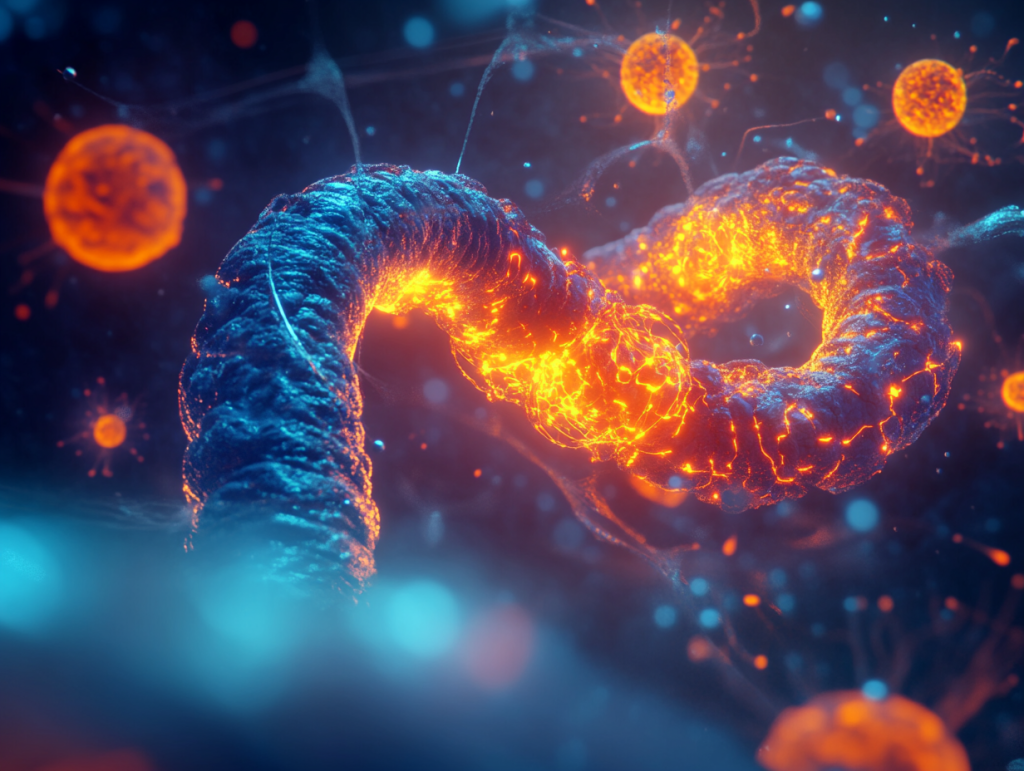
In immunological terms, Vritra may correspond to coiled or obstructive biological agents — such as pathogenic biofilms, parasitic helminths, or fibrin clots — that wind themselves around life-supporting channels, withhold flow, and resist immune force. Like a serpent hoarding the waters, these structures are only resolved when a decisive immune strike — the vajra — is activated.
This is not a metaphor for a storm or a monsoon. It is the body’s immune yajna rendered as divine mythology.
Why This Interpretation Matters
- It reclaims Indian scriptures as sophisticated inner science.
- It proposes that ancient yogis, in deep states of samadhi, may have perceived these micro-battles directly and expressed it creatively.
- It bridges consciousness with biology, mythology with immunology.
- Symbolic meditation (e.g., visualizing yajna or invoking Indra) may influence somatic states via the nervous and immune systems.
The Battlefield is Within
The Mahabharata says, “The real war is within.” The same is true of the Rig Veda. Every mantra, deity, and yajna may correspond to an inner function, a cellular ritual, or an immune strike.
Next time you feel unwell, close your eyes. Imagine the yajna beginning. Soma rising. What you imagine may not be fiction. It may be your body remembering what the rishis once saw.
Toward a Vedic Immunobiology
We are only beginning to decode the ancient hymns. But a new question emerges: Can Vedic symbols be consciously harnessed to guide immune health?
The Vedic Inner Codex points to a future where meditation, mantra, and medicine merge. In that world, the battlefield is not only real but sacred.
Coming next: What is Soma? Exploring the ancient pharmacology of inner nectar.






 Rise of Kalki
Leave a comment